

For most of the past two decades, the math of investing was shaped by a single, quietly dominant fact: capital was nearly free. Interest rates across the developed world had been falling since the 1980s, and after the financial crisis of 2008, central banks drove them close to zero and kept them there. That environment had profound consequences for how assets were valued, how businesses were built, and how much risk investors could afford to take without fully reckoning with the consequences.
That era is over.
The trigger was inflation, but the cause runs deeper. When prices began rising sharply in 2021 and 2022, the initial instinct, shared by central banks and most market participants, was that it was “transitory” and would soon pass. It did not pass quickly enough, and the Federal Reserve was forced to raise rates at one of the fastest paces in modern history.
Bucking the Trend – Historical 10-Year Treasury Yield (%)1
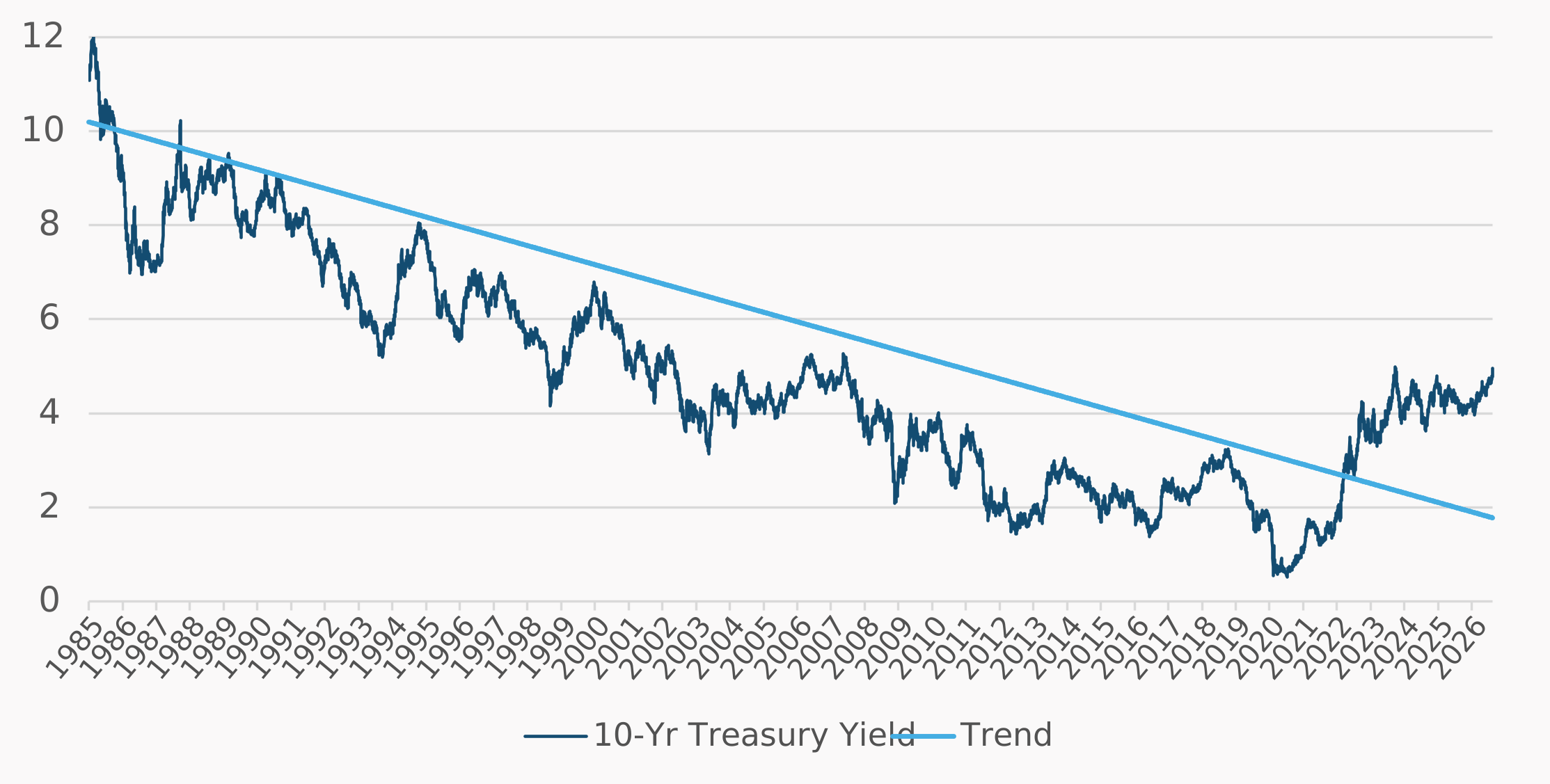
The rise in inflation and subsequent jump in rates were driven by a structural shift in how the global economy is organized, one that has been building for years and is now accelerating. For most of the past four decades, the world benefited from an expanding, increasingly integrated system of trade. Goods moved across borders with minimal friction. Supply chains stretched around the globe in search of the lowest cost. The result was a long period of falling prices for manufactured goods, which acted as a persistent brake on inflation even as economies grew.
That system is now being unwound. The forces driving the reversal are well-documented: geopolitical competition, supply chain vulnerabilities exposed by the pandemic, and a bipartisan political consensus in the United States and elsewhere that critical industries should be produced domestically rather than sourced abroad. Whatever the merits of those decisions, they have an economic cost. Rebuilding supply chains domestically is more expensive than importing. Maintaining strategic reserves and redundant capacity is inherently less efficient than optimization. More friction means higher costs, and higher costs, sustained over time, mean structurally higher inflation than the world grew accustomed to during the era of globalization.
For investors, this matters in a precise and quantifiable way. The value of any asset today is determined by the cash flows it is expected to produce in the future, discounted back to the present at some rate that reflects the cost of capital. When that discount rate was near zero, even cash flows far in the future were worth almost as much as cash flows today. That made assets with long runways of future growth (e.g., software businesses, growth companies, speculative ventures) look extraordinarily valuable. A dollar of earnings ten years from now, discounted at 2%, is worth about 82 cents today. Discounted at 8%, it is worth about 46 cents.
That arithmetic explains why so much has changed. It is not that the businesses themselves are necessarily worse. It is that the rate used to translate future promises into present value has moved materially, and for businesses whose value was heavily concentrated in distant assumptions, the impact has been severe.
Small Adjustments to Model Parameters Meaningfully Change Valuation
Discount Rate & Terminal Value Impact on Multiples2
| 2021 | 2026 | |
| Year 1 Growth | 40.0% | 40.0% |
| Year 10 Growth | 8.0% | 8.0% |
| Terminal Growth Rate | 5.0% | 3.0% |
| WACC / Discount Rate | 8.0% | 12.0% |
| Implied EV / Earnings | 31.6x | 9.5x |
Private software transactions illustrate the point starkly. In the peak years of the zero-rate era, deals routinely closed at 30 times earnings or more, with the average reaching nearly 40 times in the second half of 2022. In many of those models, the majority of enterprise value, often more than 80%, resided not in near-term cash flows but in a “terminal value”: an assumption about what the business would be worth at some point a decade or more in the future. In a world where those distant assumptions were treated as nearly as reliable as money in hand, that math was defensible. In a world of higher rates and genuine uncertainty about which business models will survive technological disruption, it is much harder to sustain.
The broader implication is not that growth is dead or that all long-duration assets should be avoided. It is that the margin for error has narrowed considerably. Investments that worked in a low-rate, stable-growth, abundant-liquidity world were in many cases more fragile than they appeared, relying on assumptions that could only be sustained so long as the conditions that created them persisted. Now that those conditions have changed, the fragility is becoming visible.
The environment that is taking shape favors assets with different characteristics: tangible collateral, near-term cash flows, and value that does not depend on a decade of uninterrupted growth to justify today’s price. It also places a greater premium on discipline, on distinguishing between assets that genuinely hold their value under stress and those that merely appeared to while conditions were benign.
That distinction may matter more in the years ahead than it did in the years behind us.
Footnotes
1. As of September 10, 2026. Source: Board of Governors of the Federal Reserve System (US) via FRED® “10-Yr Treasury Yield” is represented by Market Yield on U.S. Treasury Securities at 10-Year Constant Maturity
2. For illustrative purposes only based on Kennedy Lewis’ views. There are no guarantees that historical trends will continue.
Important Disclosures
Past performance is not a guarantee of future results.
The material presented is proprietary information regarding Kennedy Lewis Investment Management LLC and its affiliates, including Kennedy Lewis Capital Company (the “Company”) and Kennedy Lewis Capital Holdings LLC (the investment advisor to the Company) (collectively, “Kennedy Lewis”). as well as investment held by the Kennedy Lewis Funds.
The views expressed and, except as otherwise indicated, the information provided is as of the report date and is subject to change, update, revision, verification, and amendment, materially or otherwise, without notice, as market or other conditions change. Since these conditions can change frequently, there can be no assurance that the trends described herein will continue or that any forecasts are accurate. In addition, certain of the statements contained in this material may be statements of future expectations and other forward-looking statements that are based on the current views and assumptions of Kennedy Lewis and involve known and unknown risks and uncertainties (including those discussed below) that could cause actual results, performance, or events to differ materially from those expressed or implied in such statements. These statements may be forward-looking by reason of context or identified by words such as “may, will, should, expects, plans, intends, anticipates, believes, estimates, predicts, potential or continue” and other similar expressions. Neither Kennedy Lewis, its affiliates, nor any of Kennedy Lewis’ or its affiliates’ respective advisers, members, directors, officers, partners, agents, representatives or employees or any other person (collectively the “Kennedy Lewis Entities”) is under any obligation to update or keep current the information contained in this document.
This material contains information from third party sources which Kennedy Lewis has not verified. No representation or warranty, express or implied, is given by or on behalf of the Kennedy Lewis Entities as to the accuracy, fairness, correctness or completeness of the information or opinions contained in this material and no liability whatsoever (in negligence or otherwise) is accepted by the Kennedy Lewis Entities for any loss howsoever arising, directly or indirectly, from any use of this material or its contents, or otherwise arising in connection therewith.
All investments are subject to risk, including the loss of the principal amount invested.
These risks may include limited operating history, uncertain distributions, inconsistent valuation of the portfolio, changing interest rates, leveraging of assets, reliance on the investment advisor, potential conflicts of interest, payment of substantial fees to the investment advisor and the dealer manager, potential illiquidity, and liquidation at more or less than the original amount invested.
This material is for informational purposes only and is not an offer or a solicitation to sell or subscribe for any fund and does not constitute investment, legal, regulatory, business, tax, financial, accounting, or other advice or a recommendation regarding any securities of Kennedy Lewis, of any fund or vehicle managed by Kennedy Lewis, or of any other issuer of securities. Only a definitive offering document (i.e.: Prospectus or Private Placement Memorandum) can make such an offer.
Copyright© Kennedy Lewis Investment Management LLC. 2026. All rights reserved.
This material is proprietary and may not be reproduced, transferred, or distributed in any form without prior written permission from Kennedy Lewis. It is delivered on an “as is” basis without warranty or liability by accepting the information, you agree to abide by all applicable copyright and other laws, as well as any additional copyright notices or restrictions contained in the information.