

The hard part used to be finding assets worth owning. Now it is funding the ones the economy actually needs built — and the vehicles that won the last era may be the wrong tool for it.
It is worth asking what problem an investment strategy is designed to solve, because the answer changes with the environment. For most of the past fifteen years, we lived in a low-rate world where capital was abundant and cheap. The difficulty was not raising money or funding projects; it was finding assets worth owning at a reasonable price. In that world, the winning approach was to own as much of the market as possible, as cheaply as possible: broad, liquid, low-fee, index-based exposure. It was the right answer, and it deservedly attracted trillions of dollars.
The problem has changed. Capital is now scarce relative to the demands on it, from governments, from the AI build-out, from reshoring and rearmament. And the assets that most need financing have changed character. They are physical and long-lived rather than digital and asset-light: power plants, electrical grids, factories, housing, defense capacity. The constraint has moved from finding things to own to funding what needs to be built, and those are not the same skill.
The Pendulum Has Swung
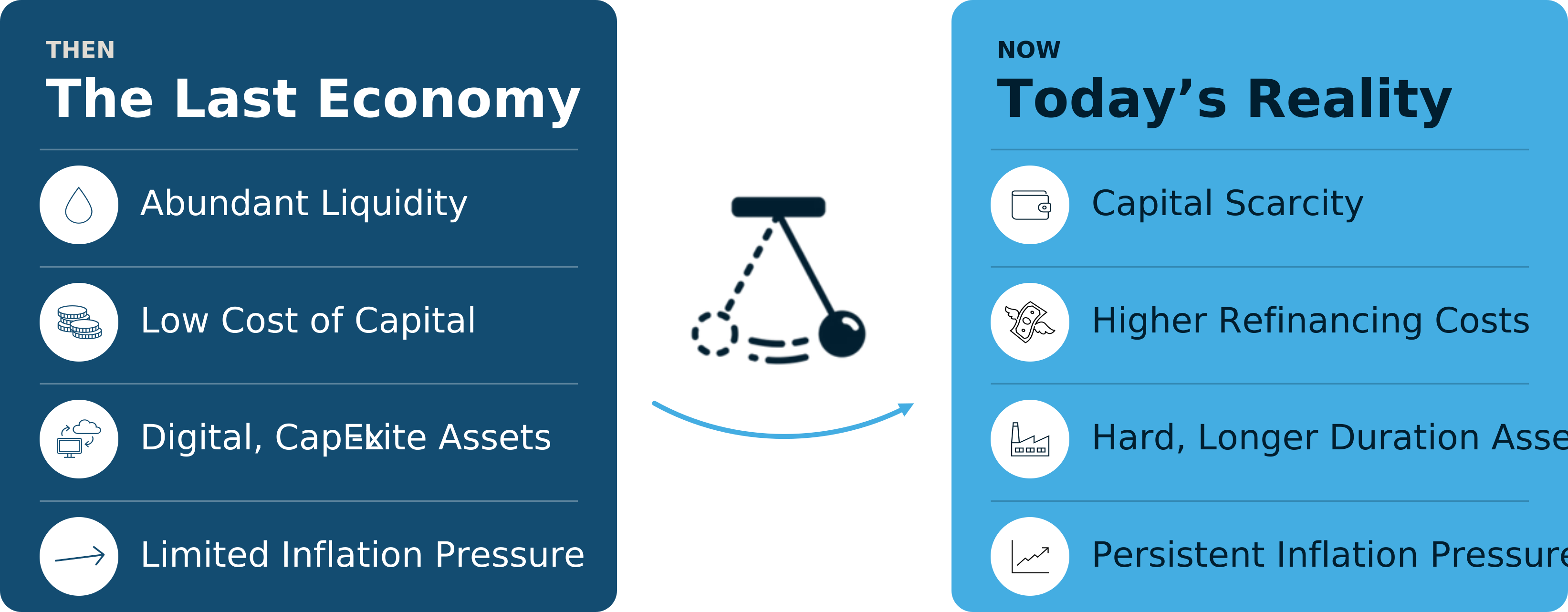
Liquidity and Breadth Were the Point – They Have Become a Limitation
The vehicles that dominate today were engineered for the old problem. Their defining virtues are liquidity and breadth: they hold thousands of securities that can be bought and sold instantly at an observable price. That is precisely what made them so good at owning the market cheaply. It is also what makes them unsuited to the task at hand. The assets this cycle requires trade rarely, price opaquely, take judgment to underwrite, and carry durations that only committed, long-term capital can hold. A vehicle that promises daily liquidity cannot own a ten-year loan against a power project under construction. A strategy that tracks an index cannot finance an asset that belongs to no index. The features that were strengths in a low-rate era of abundance are limitations in an era of scarcity.
Where the Index Points, and Where It Doesn’t
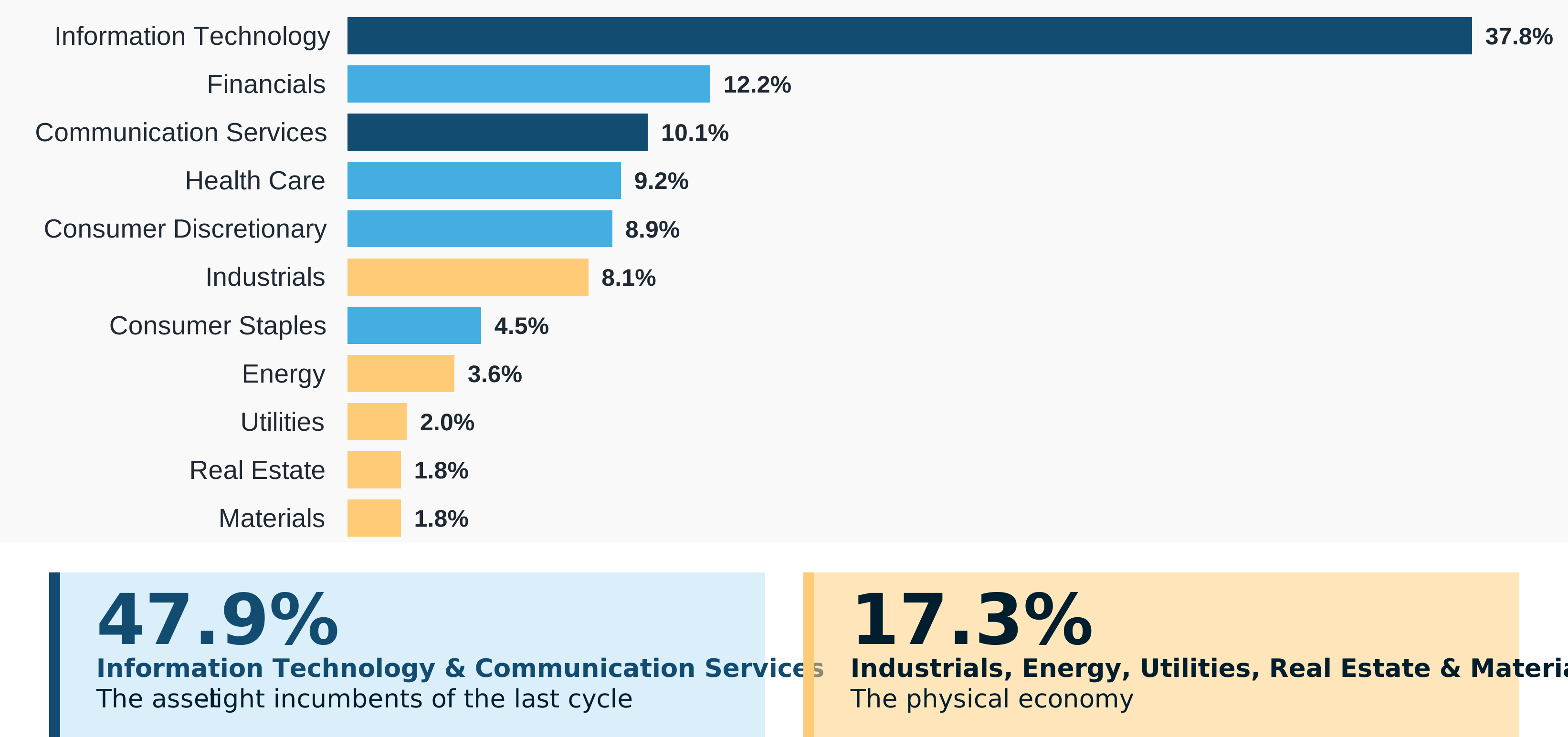
The mismatch is visible in the composition of the market itself. The S&P 500 is now concentrated in technology and communication-services businesses to a degree without modern precedent, while the sectors most central to the physical economy (utilities, industrials, materials, real estate) sit at low single-digit weights. A dollar of broad passive equity is therefore overwhelmingly a claim on the asset-light incumbents of the last cycle and barely a claim on the parts of the economy now being rebuilt. Investor attention and flows concentrate where the index is heavy, which is to say where growth has already happened, not where capital is most needed next.
Where the Index is Heavy, and Where It Isn’t1
S&P 500 Weight by GICS sector
The Case for Underwriting, Made Narrowly
We would frame the conclusion carefully, because it is easy to overstate. We are not arguing that active management beats passive as a general proposition. In deep, liquid, continuously priced markets, it usually does not, and indexing will keep making sense there. Our claim is narrower and structural. The economy’s investment priorities have moved toward long-duration assets just as the price of capital has moved sharply higher. Matching scarce capital to those assets must be done deal by deal, by people who can price risk that has never been indexed. Vehicles built for liquidity and breadth are poorly suited to it, and the banking system, constrained by post-crisis capital rules, is structurally limited from holding this credit at scale.
That is the case for private, actively managed capital. Not as a replacement for public markets, which will remain the right home for liquidity, breadth, and cost efficiency, but as the part of a portfolio built to do the thing the index cannot: fund the physical, long-lived assets a transitioning economy depends on, and be paid for the scarcity and the underwriting that funding requires. When the binding constraint is no longer finding assets but financing them, the ability to underwrite what no index can hold stops being a niche and becomes the point.
Footnotes
1. Source: Bloomberg, S&P 500 GICS sector weights. Illustrative; index weights change over time. Technology and communication services are shown together because the largest platform businesses sit across both.
Important Disclosures
Past performance is not a guarantee of future results.
The material presented is proprietary information regarding Kennedy Lewis Investment Management LLC and its affiliates, including Kennedy Lewis Capital Company (the “Company”) and Kennedy Lewis Capital Holdings LLC (the investment advisor to the Company) (collectively, “Kennedy Lewis”). as well as investment held by the Kennedy Lewis Funds.
The views expressed and, except as otherwise indicated, the information provided is as of the report date and is subject to change, update, revision, verification, and amendment, materially or otherwise, without notice, as market or other conditions change. Since these conditions can change frequently, there can be no assurance that the trends described herein will continue or that any forecasts are accurate. In addition, certain of the statements contained in this material may be statements of future expectations and other forward-looking statements that are based on the current views and assumptions of Kennedy Lewis and involve known and unknown risks and uncertainties (including those discussed below) that could cause actual results, performance, or events to differ materially from those expressed or implied in such statements. These statements may be forward-looking by reason of context or identified by words such as “may, will, should, expects, plans, intends, anticipates, believes, estimates, predicts, potential or continue” and other similar expressions. Neither Kennedy Lewis, its affiliates, nor any of Kennedy Lewis’ or its affiliates’ respective advisers, members, directors, officers, partners, agents, representatives or employees or any other person (collectively the “Kennedy Lewis Entities”) is under any obligation to update or keep current the information contained in this document.
This material contains information from third party sources which Kennedy Lewis has not verified. No representation or warranty, express or implied, is given by or on behalf of the Kennedy Lewis Entities as to the accuracy, fairness, correctness or completeness of the information or opinions contained in this material and no liability whatsoever (in negligence or otherwise) is accepted by the Kennedy Lewis Entities for any loss howsoever arising, directly or indirectly, from any use of this material or its contents, or otherwise arising in connection therewith.
All investments are subject to risk, including the loss of the principal amount invested.
These risks may include limited operating history, uncertain distributions, inconsistent valuation of the portfolio, changing interest rates, leveraging of assets, reliance on the investment advisor, potential conflicts of interest, payment of substantial fees to the investment advisor and the dealer manager, potential illiquidity, and liquidation at more or less than the original amount invested.
This material is for informational purposes only and is not an offer or a solicitation to sell or subscribe for any fund and does not constitute investment, legal, regulatory, business, tax, financial, accounting, or other advice or a recommendation regarding any securities of Kennedy Lewis, of any fund or vehicle managed by Kennedy Lewis, or of any other issuer of securities. Only a definitive offering document (i.e.: Prospectus or Private Placement Memorandum) can make such an offer.
Copyright© Kennedy Lewis Investment Management LLC. 2026. All rights reserved.
This material is proprietary and may not be reproduced, transferred, or distributed in any form without prior written permission from Kennedy Lewis. It is delivered on an “as is” basis without warranty or liability by accepting the information, you agree to abide by all applicable copyright and other laws, as well as any additional copyright notices or restrictions contained in the information.